
The Bank of England has raised the base rate from 3.75% to 4%. It was widely expected, and it has not stopped lenders competing for your business. Several lenders reduced their mortgage rates in the days before the announcement.
There is always a positive angle in mortgage news, and the past few days are a good example. This update picks up where our Budget guide left off. It covers what the decision means whether your rate is fixed, tracker or variable, why markets around the world matter for the rate you pay, and how to decide what to do next.
WHAT HAS CHANGED SINCE THE BUDGET
On Thursday 5 November, the Bank of England’s Monetary Policy Committee voted eight to one to raise the base rate to 4%, the first rise since 2023. One member voted for a larger rise, to 4.25%. Inflation was 3.5% in September, up from 3.1% in August and above the Bank’s 2% target, with higher motor fuel prices the main driver of the latest rise, and the committee said the inflationary pressure in the pipeline was now enough to warrant an increase.
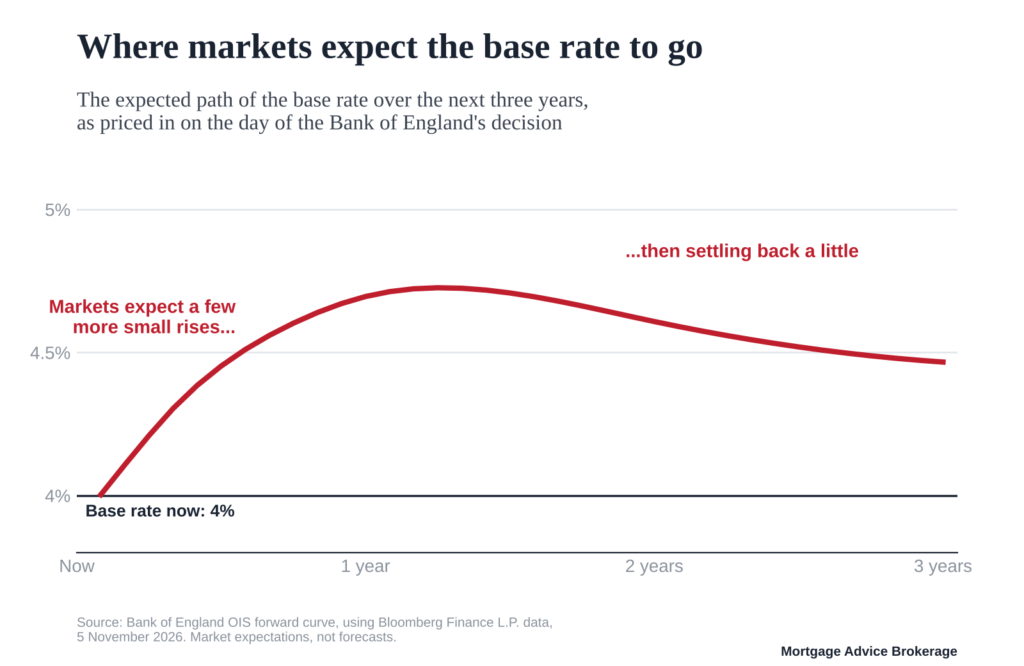
Governor Andrew Bailey said the rise should not be seen as “the first in an inevitable long sequence of hikes”, but that another increase looks likely unless the conflict in the Middle East is resolved. Markets see a further rise as possible at the next meeting on 17 December, and more likely by early next year. Nobody can say for certain, which is why we always say the same thing: talking things through early and being proactive gives you more choice, whichever way rates move.
What has not changed is that lenders still want your business. Lenders price their fixed rates on where they expect interest rates to go, not only on where the base rate stands today. When a rise has been expected for some time, much of it is already in the price, and several lenders reduced some of their mortgage rates in the days leading up to the decision.
WHAT IT MEANS FOR YOU
How the rise affects you depends on the type of mortgage you have and when your deal ends.
| Your situation | What happens now | What to consider |
|---|---|---|
| Fixed rate, ending in more than six months | Nothing changes. Your rate and payment stay the same until the deal ends. | You can usually arrange your next rate up to six months ahead with a new lender, and around three/four months ahead with your current lender. |
| Deal ending in the next six months | Your current deal is unaffected, but your next rate is being priced now. | This is the time to look at your options. If a better rate appears before your new deal starts, we can look at switching with the same lender. |
| Tracker | Your rate follows the base rate at a set margin, so your rate and monthly payment move with it. As a rough guide, each 0.25% rise adds around £14 to £15 a month for every £100,000 borrowed on a 25-year repayment mortgage. | Check whether your tracker has any early repayment charge, and whether fixing for certainty would suit you better. |
On a standard variable rate, or thinking of buying? Our Budget guide covers both in more detail, and we are always happy to talk it through.
WHY EVENTS ABROAD MATTER
Fixed mortgage rates are priced off swap rates, which reflect where financial markets expect interest rates to go. Those expectations are shaped by what happens around the world, not only by the Bank of England.
The past few days are a good example. The US midterm elections were held on 3 November, and markets in Asia moved in different directions the following day. Oil prices fell sharply after the results, with Brent dropping to around $95 a barrel on 4 November, its lowest level in almost two months, as markets weighed what the outcome could mean for the conflict in the Middle East. Energy prices feed into inflation and into what markets expect from central banks, so moves like this matter for the rate you pay. Central banks are also moving at different speeds. Australia raised rates on 3 November, while the US Federal Reserve and the European Central Bank both held at their October meetings.
Nobody can say for certain where rates will go next, and even the best economists find it hard to call. That is why we focus on the timing and the type of deal that suits you, rather than trying to guess the market.
We have seen an increase in clients choosing three-year fixes, and the reason is often what lies ahead. A fix taken out now runs beyond the next US presidential election in November 2028 and the UK general election, which must be held by August 2029, so clients can have their rate settled while those events play out.
WHAT TO DO NOW
Start by checking when your current deal ends. With just a few details from your mortgage statement, we can check the date for you and get you set up with us. If your deal ends in the next few months, we can look at your options straight away. In most cases, from around three to four months before it ends, we can reserve a new rate with your current lender, and if a better rate comes up before it starts, we can switch you onto it. A new lender can usually hold a rate for up to six months ahead, so we can look at both. If your deal is further away, we will set a reminder and get in touch when the time is right. We search the whole market, including the deals your own lender offers existing customers, so you see every option in one place, and we will help you decide between the certainty of a fixed payment and the flexibility of something else. In most cases, our advice is fee free.
THE BOTTOM LINE
The base rate has gone up, but that does not mean your options have shrunk. Lenders are competing for business, rates move from week to week, and the right advice can still make a real difference to what you pay.
The Bank of England’s next decision is on 17 December, and another rise is possible then or early next year. If your deal ends in the next few months, or you are thinking of buying, get in touch and we will talk you through it.
TALK IT THROUGH
If you need independent mortgage advice, book a video call, give us a ring, or pop into our office in Dunblane or Glasgow for a chat over a coffee. We have been helping clients across Scotland and the UK with their mortgages since 2001, and we genuinely love what we do. Email us below or book a meeting via the link above.
Email us below or book a meeting via the link above.

———————————————————————————
IMPORTANT INFORMATION
Your home may be repossessed if you do not keep up repayments on your mortgage. Mortgage Advice Brokerage is authorised and regulated by the Financial Conduct Authority (FCA: 479200). The information contained in this article is for guidance purposes only and does not constitute advice. Your individual circumstances will affect which mortgage products are available to you.